
This research has been developed within the framework of project PID2020-116036RB-I00, funded by the Ministerio de Ciencia, Innovación y Universidades and the Agencia Estatal de Investigación (MICIU/AEI).
The Rhythms of the City of Barcelona
A city is a dynamic system where the personal rhythms of each individual shape its global rhythm. The result of this research is an interactive map that allows you to visualise the urban fabric in relation to the rhythm of its inhabitants, using the city of Barcelona as a case study.
This map has been produced by the research group in Architecture, Energy and Environment (AiEM), affiliated with the Barcelona School of Architecture (ETSAB) at the Universitat Politècnica de Catalunya - BarcelonaTech (UPC).

#The rhythm of buildings
Every citizen has their own rhythm of life: they wake up, commute, eat and sleep at different times. The coexistence of these individual rhythms determines the rhythm of the city. Understanding these personal rhythms would require a great deal of time; it is a task that is probably impossible given the large number of individual cases. However, buildings—the places where individual activities take place—have their own rhythm, and these can be objectively and systematically analysed.
This study takes as a reference the 172 uses registered in the Cadastre and classifies them according to the type of rhythm:
- Regular Rhythm: uses with a repetitive occupied/unoccupied pattern, such as offices and schools.
- Variable Rhythm: uses with sporadic or punctually concentrated occupancy, such as shops, restaurants, museums, sports centres and theatres.
- Intensive Rhythm: uses that cannot be considered unoccupied, such as hospitals, healthcare centres, dwellings and residences.
#The method
When generating the map of the city's rhythms, a challenge arises: many buildings do not have a single rhythm or use. It is common to find cases such as residential blocks (intensive rhythm) with shops on the ground floor (variable rhythm) and offices on the first floor (regular rhythm), or an office building (regular rhythm) with a restaurant on the ground floor (variable rhythm).
To represent this complexity in a two-dimensional map, the primary colorimetric space CMY (cyan, magenta and yellow) is used.
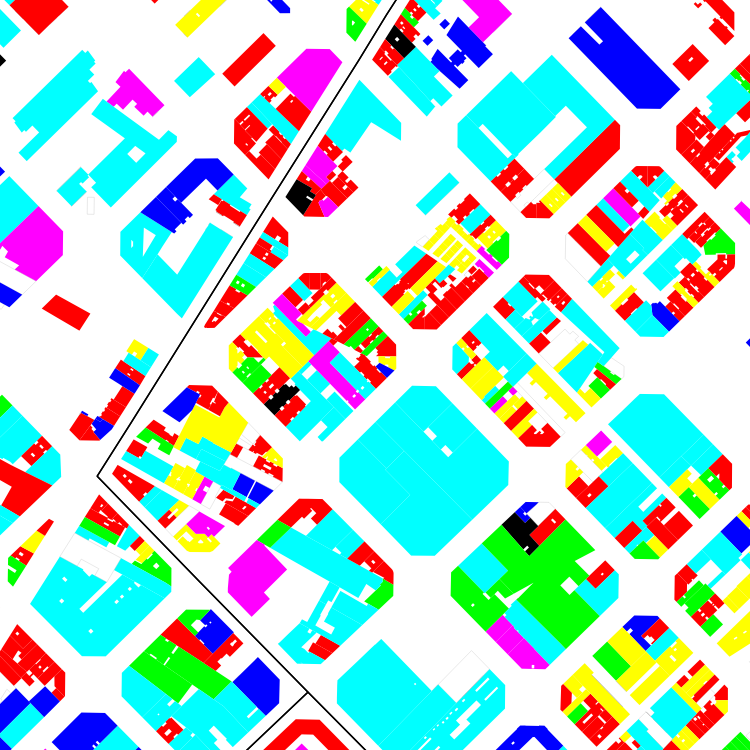
The intensive rhythm is assigned the colour yellow; the variable rhythm, magenta; and the regular rhythm, cyan. If a building has more than one type of rhythm, it is represented according to the subtractive mixing of the two or three colours that make up the three primary rhythms. For example, a building with a shop on the ground floor (variable rhythm: magenta) and dwellings on the upper floors (intensive rhythm: yellow) will use the colour red. A building containing all three rhythms (intensive, variable and regular) will therefore be represented in black.
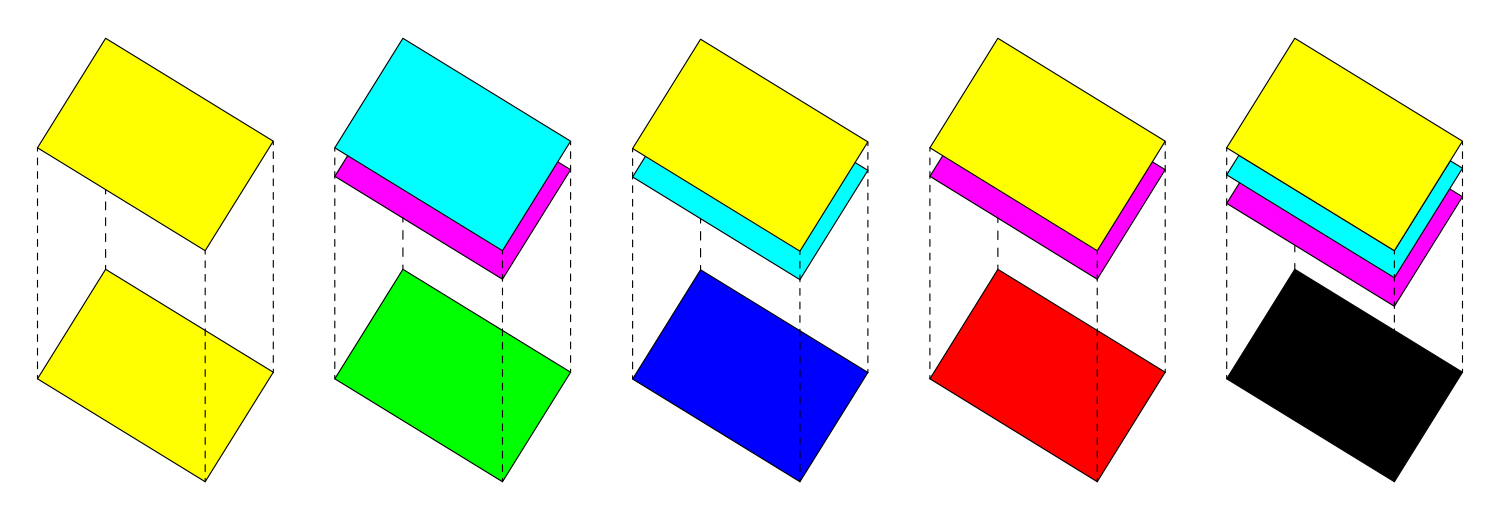
Subtractive mixing used to represent the superposition of rhythms on the map.
#Analysis of results
When we look at the rhythm map of Barcelona, we can see that the various urban fabrics of the city have different rhythms. Historic districts such as Gràcia, Sarrià, Sant Andreu, Poblenou and Barceloneta are easily distinguishable. Some singular areas are also noticeable, such as the industrial estates of Zona Franca and La Verneda, or the Zona Universitària.
However, in other areas such as the Eixample, despite having a homogeneous urban fabric, singularities can be observed in specific zones, such as Passeig de Gràcia or the 22@ district. In areas like El Raval, it is also possible to see how rhythms change as we approach Las Ramblas.
Passeig de Gràcia: The extract of the Passeig de Gràcia area shows the characteristic urban fabric of Barcelona's Eixample Cerdà, with rectangular blocks and chamfered corners, and a heterogeneous and diverse colour distribution. We find all three primary colours (cyan, magenta and yellow) through to black, a testament to the diversity of rhythms that coexist in this central part of the city.
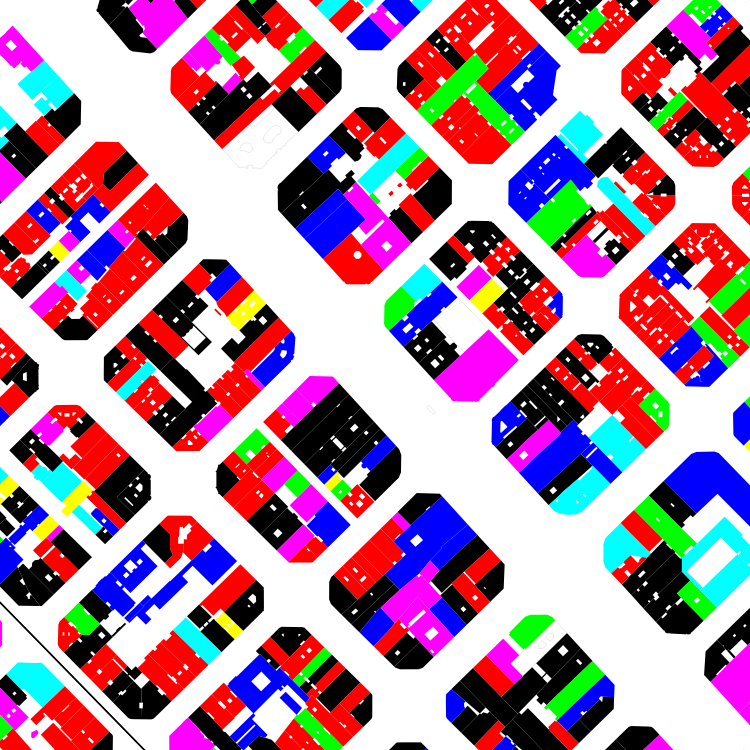
22@: The 22@ area also follows the Eixample Cerdà urban fabric, but features a very different colour distribution compared to the Passeig de Gràcia extract. In this case, the predominant colour is cyan, corresponding to the office buildings and industrial facilities that define this part of the city.
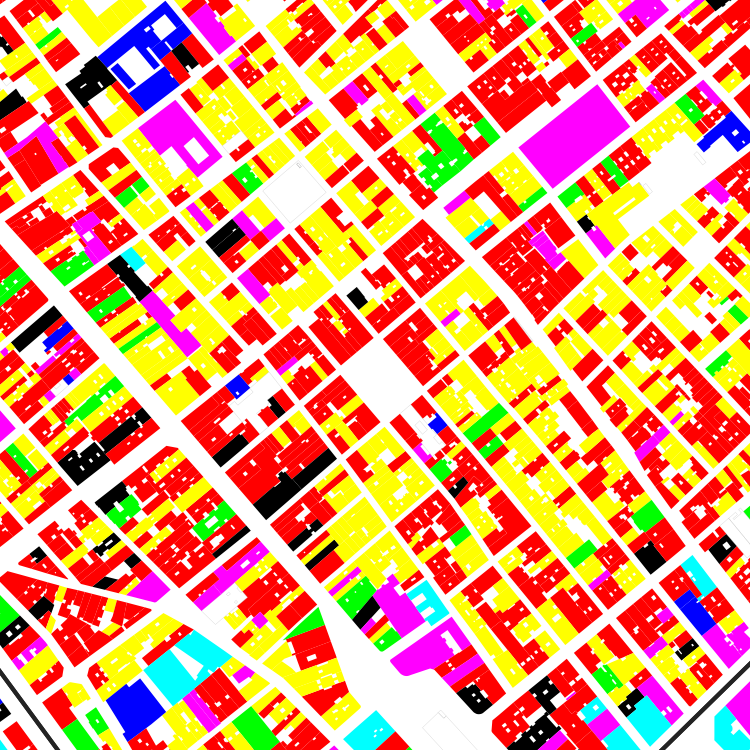
Gràcia: The Gràcia neighbourhood in Barcelona has an urban fabric of narrow streets and party-wall buildings arranged in an irregular rectangular grid. The rhythms in this area are predominantly intensive (yellow), mainly corresponding to multi-family residential buildings. Red is present and identifies buildings with a shop on the ground floor and dwellings above. The isolated variable rhythm, in magenta, identifies purely commercial, sporting or cultural buildings.
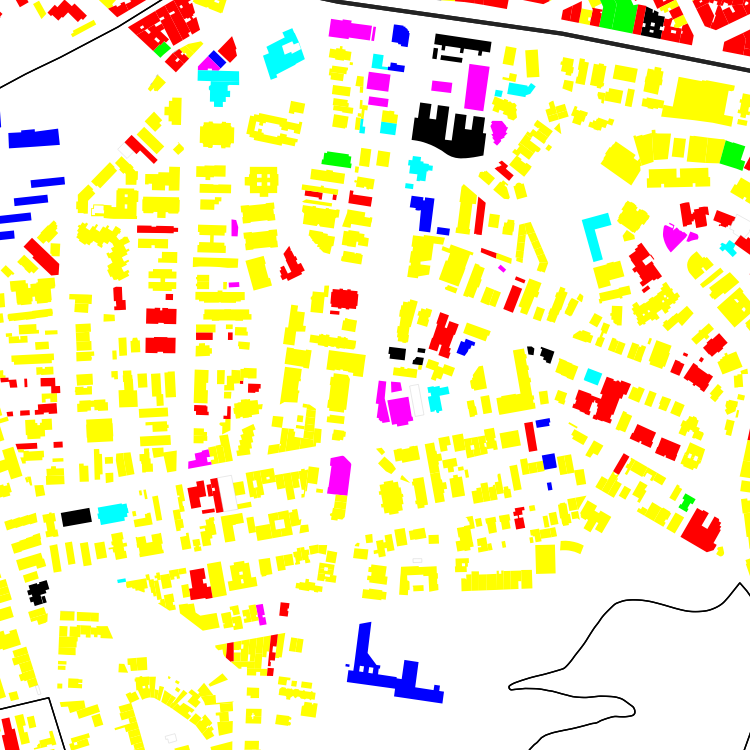
La Font d'en Fargues: This Barcelona neighbourhood lies in a steeply sloping area between El Carmel and El Guinardó. The buildings are mostly detached, surrounded by gardens, and single-family and multi-family detached dwellings in yellow predominate. The extract shows some buildings with a regular rhythm, corresponding to educational centres, and some others with a variable rhythm in magenta, such as markets, sports centres or religious buildings. Few buildings combine dwellings (intensive rhythm) with shops (variable rhythm), shown in red.