TELA: Thermal Envelope Light Adapter

TELA is a system that merges curtains and thermal insulation. It has been developed by the Architecture, Energy and Environment research group (AiEM), affiliated with the Barcelona School of Architecture (ETSAB) at the Universitat Politècnica de Catalunya - BarcelonaTech (UPC), and offers an adaptable response to changing climatic conditions.
This project arises from the need to adapt existing buildings to an increasingly common climatic situation, where the same territory experiences ever more drastic temperature swings. Moreover, the TELA system can be installed without any intervention on the building, streamlining installation and reducing costs.

#The problem

Buildings currently fail to adapt to changing climatic conditions. Most of the building stock relies on fixed climatic solutions that are increasingly obsolete. Temperatures are becoming ever more variable, and buildings need to adapt to these changes without active systems such as air conditioners or fans. This is where TELA comes in — a system that makes it possible to face these new realities.
TELA requires no construction work. It installs on existing windows, is compatible with protected and heritage buildings, and can be removed at any time without leaving a trace. The cost is significantly lower than any conventional retrofit, and the user keeps full control over their environment.

Switch to double glazing

Intervention on the opening

Switch to double glazing

Façade insulation

Intervention on the façade

Façade insulation

TELA solution

Intervention on the opening and the façade

TELA solution

#The product

The TELA curtain is a translucent textile device installed in front of the window. When deployed, it creates an air chamber between the fabric and the glass that acts as a thermal barrier: it reduces heat loss by up to 69% in winter and limits solar radiation gains in summer.
Light passes through the material diffusely, without glare, keeping a soft and even indoor lighting. The material structure also absorbs part of the outdoor noise.

#System components

  • Fabrics: two layers of reflective white fabric with 10 mm fire-resistant translucent batting. Low emissivity on the inner surface to maximise long-wave radiation reflection.
  • Tracks: 5-channel Japanese panel system allowing smooth, silent lateral movement of each panel independently.
  • Motor: tubular motor with integrated encoder. Enables precise positioning, obstacle detection and scheduled operation.
  • IT system: controller compatible with Zigbee, Wi-Fi, Matter and Apple HomeKit. Integrates into existing home-automation ecosystems with no dedicated hub.
Diagram showing the different components of the TELA system

#How it works

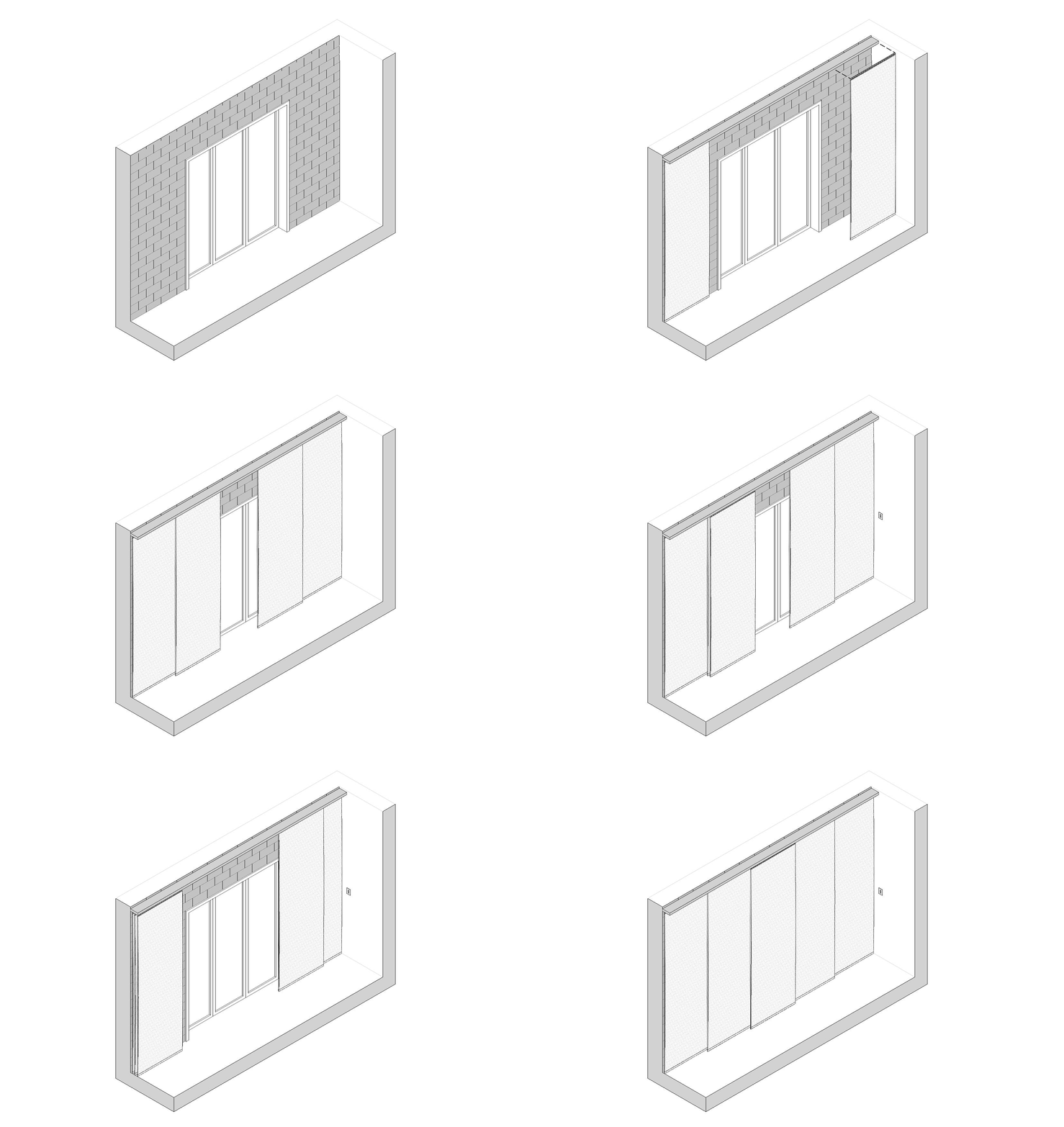
In winter, the deployed curtains create an air chamber between the fabric and the glass that slows heat loss to the outside. Indoor radiant temperature improves noticeably. Natural light still enters diffusely, without sacrificing the space’s lighting.

In summer, the reflective white fabric deflects solar radiation and reduces indoor heat gains. The space stays cool with no need for additional air conditioning. Light passes through the material diffusely, eliminating direct glare while keeping a soft indoor lighting.

TELA operation in winter - step 1TELA operation in winter - step 2TELA operation in winter - step 3TELA operation in summer - step 1TELA operation in summer - step 2TELA operation in summer - step 3
Diagram of TELA operation in winter and summer.

#Measured results

The TELA prototype has been tested under real conditions at UPC Barcelona. The results demonstrate a significant reduction in radiant temperature and U-value, with remarkable preservation of natural light.
All measurements were taken with the prototype under real-use conditions, with no controlled laboratory conditions. The results can be found in the scientific paper published in Journal of Physics: Conference Series (PLEA 2024, Wrocław).
20–30%

Natural light preserved with TELA deployed

−2.2°C

Radiant temperature reduction (24.6°C with TELA vs 26.8°C without)

−69%

U-value reduction (from 5 to 1.53 W/m²K)

Scientific reference: Roca-Musach, M., Crespo Cabillo, I., Coch Roura, H. (2025). Adaptability and thermal well-being with dynamic screens: buildings also change their wardrobe. Journal of Physics: Conference Series 3140. PLEA 2024, Wrocław.


#Impact

40%

of Europe’s building stock needs affordable energy renovation

Features TELA Single glazing Double glazing Ext. insulation
Thermal efficiency ●●● ●●● ●●● ●●●
Cost savings ●●● ●●● ●●● ●●●
Flexibility ●●● ●●● ●●● ●●●
Compatible with existing buildings ●●● ●●● ●●● ●●●
Dynamic control ●●● ●●● ●●● ●●●