
Methodology used
The radiant environment: What is it? How to see it?
The spherical thermography images produced by the Architecture, Energy and Environment (AiEM) research group, linked to the Escola Tècnica Superior d'Arquitectura de Barcelona (ETSAB) at the Universitat Politècnica de Catalunya - BarcelonaTech (UPC), make it possible to represent the surrounding long-wave radiant environment.
The research team used a thermal camera to produce several series of spherical (360º) thermal images in different locations in Barcelona. Through these images, the invisible radiant environment that we experience thermally in everyday life is represented.

This research was carried out within the framework of the VeUvE project "Urban Havens in Vulnerable Neighborhoods: Environmental public space for resilient cities" (PID2020-116036RB-I00) and the DOM-P project “Dynamic Occupancy Management of Well-Being for People” (PID2024-156720OB-I00), funded by theSpanish Ministry of Science, Innovation and Universities and theState Research Agency (MICIU/AEI /10.13039/501100011033), and ERDF, EU.
#Visualizing the radiant environment
The radiant environment is not visible to the human eye: we perceive it through our skin. However, thermal cameras are devices that detect the long-wave energy emitted by the surfaces of the environment and assign them a false color according to their radiant temperature, offering a colorimetric representation of the invisible radiant environment.
A thermal photograph makes it possible to represent both the radiant temperatures of surfaces and their distribution. The following image shows a comparison between a visible image (left) and a thermal image (right) of Plaça del Sol in Barcelona, taken on February 2, 2025.
Comparison between a visible image and a thermal image of Plaça del Sol in Barcelona, taken on February 2, 2025.
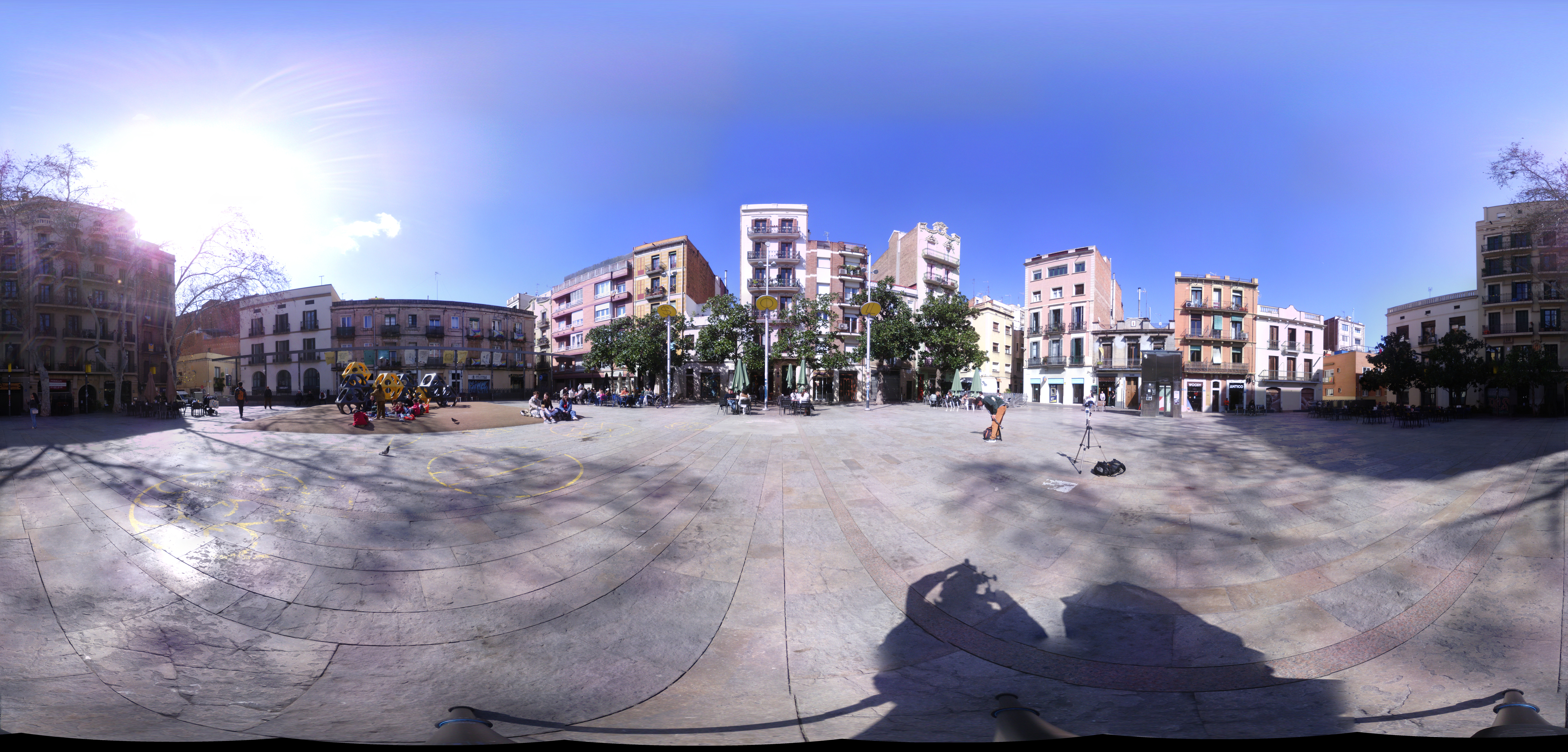
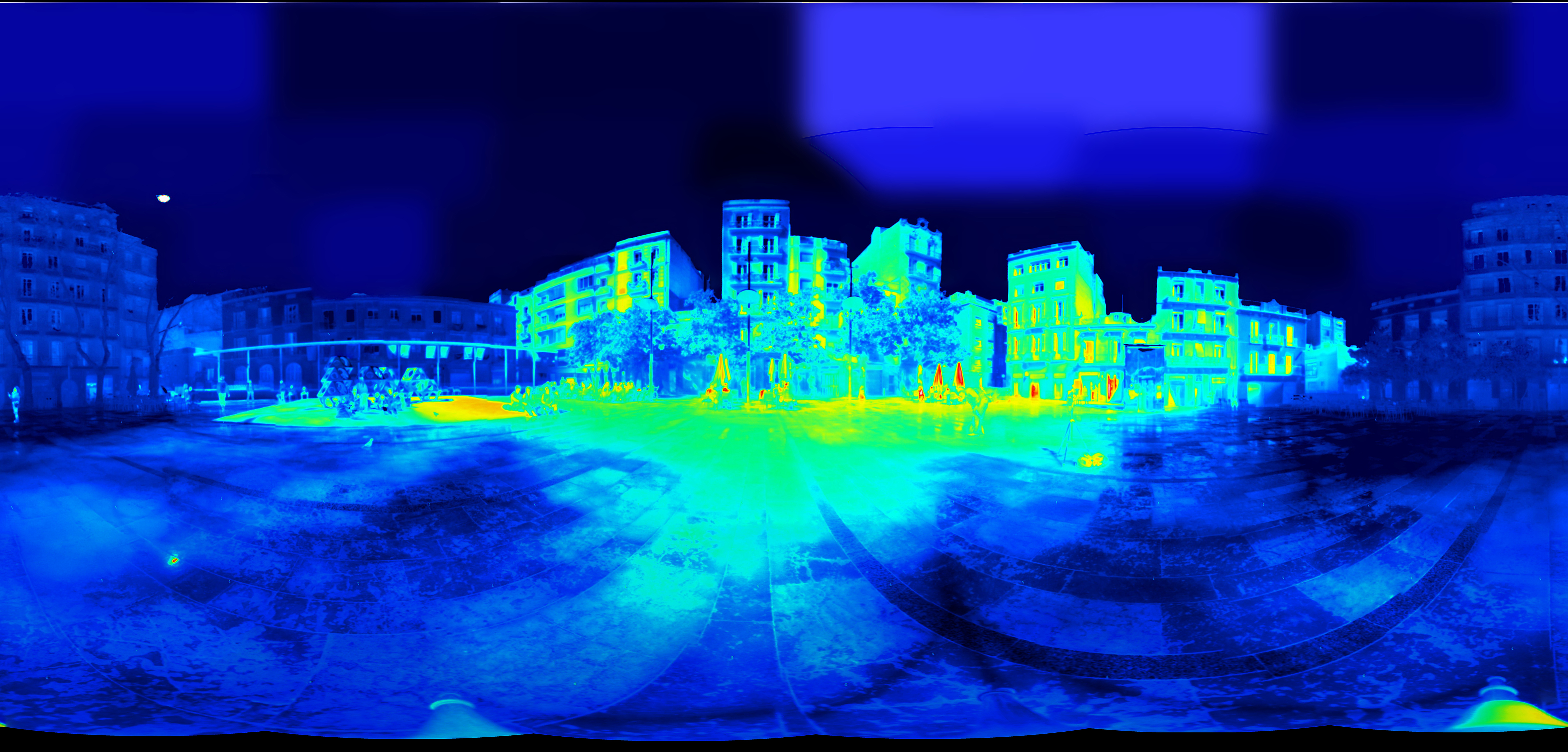
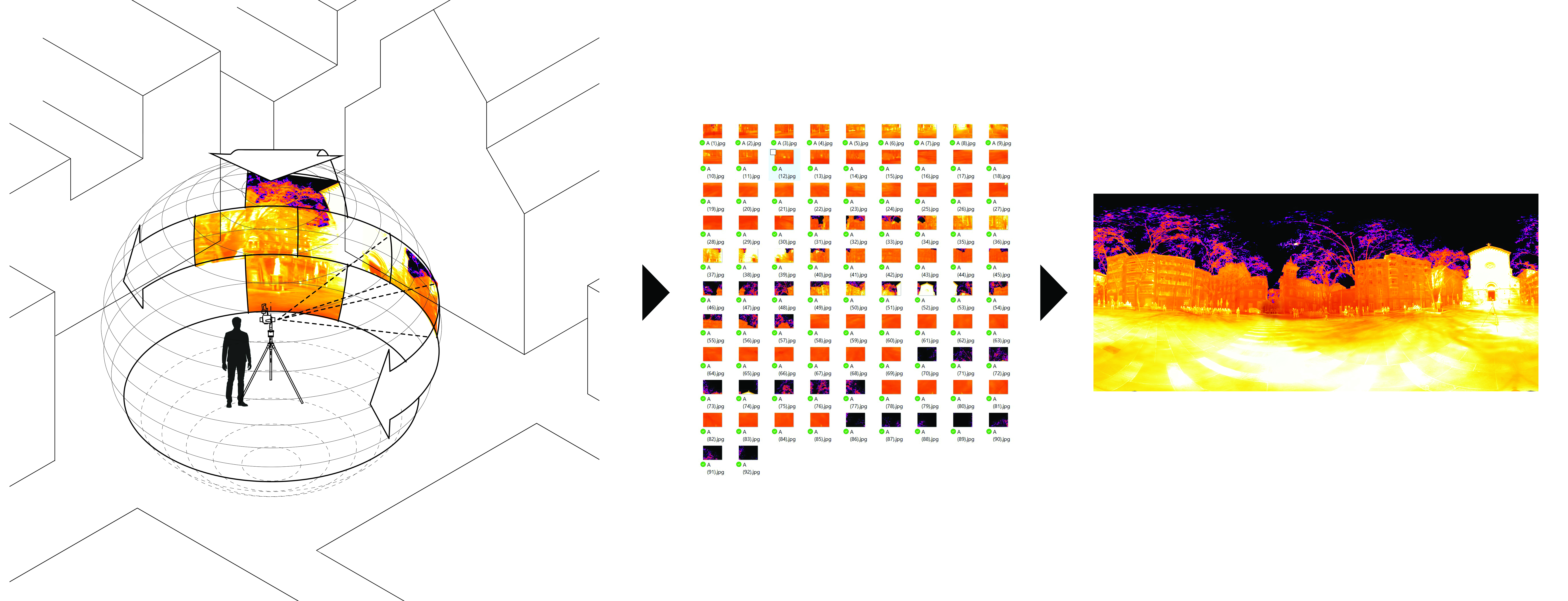
The previous image of Plaça del Sol is not a typical thermal image. It is a projection that makes it possible to represent the entire environment from a single point in one image: the projection used is called a cylindrical projection. This type of representation is similar to the images used to navigate at street level in Google Street View. Generating the previous image of Plaça del Sol is not an easy task, since thermal cameras have a small field of view.
Producing a complete thermal image like the previous one involves capturing 92 photographs using a tripod with a pan-and-tilt head, which allows precise control of the camera position, and specialized software to process and generate the final image. The following image summarizes the methodology used.
#Why is it interesting to see the radiant environment?
Seeing the radiant environment allows us to understand what is happening in our surroundings, analyze people's comfort conditions and identify the factors that influence the thermal behavior of buildings and cities. Unlike air temperature, which can be considered uniform for a given space, radiant temperature can vary significantly depending on the orientation, materials and shape of the objects around us.
We carried out the experiment of photographing the radiant environment over the course of a day, every two hours, in Plaça de la Virreina in Barcelona. The following interactive figure shows the results.
Plaça de la Virreina, Barcelona (March 31, 2025)
Loading 360º view...
