

The spherical thermography images produced by the Architecture, Energy and Environment (AiEM) research group, linked to the Escola Tècnica Superior d'Arquitectura de Barcelona (ETSAB) at the Universitat Politècnica de Catalunya - BarcelonaTech (UPC), make it possible to represent the surrounding long-wave radiant environment.
The radiant environment: What is it? How to see it?
The research team used a thermal camera to produce several series of spherical (360º) thermal images in different locations in Barcelona: parks, squares, the interior of a basilica and a dwelling. Through these images, the invisible radiant environment that we thermally experience in everyday life can be represented.

This research was carried out within the framework of project PID2020-116036RB-I00, funded by the Spanish Ministry of Science, Innovation and Universities (MICIU).
#What is the radiant environment?
The radiant environment is the sum of all the radiation around us. Imagine you are in a room with cold walls and a hot radiator. Your body receives radiation from the walls and from the radiator, but it also emits radiation. This constant exchange of radiant energy is what defines our radiant environment.
Having data on radiant temperature (Tr) is as relevant as air temperature (Ta), since both have a similar weight in the perceived sensation temperature (Ts). The human body exchanges radiant energy with its surroundings, emitting and receiving infrared (non-visible) radiation. The balance between emission and reception results in a gain or loss of energy that impacts the final thermal sensation.
#Can we see it?
At first, we perceive our radiant environment with the skin, and it is not visible to the eye. Radiant exchanges can only be understood by capturing all radiant temperatures of the environment. However, we rarely find a global representation of environmental radiant temperatures today. But we can see it with thermal cameras. These cameras detect the long-wave energy emitted by the photographed surfaces (infrared), assign radiant temperature values, and provide a colorimetric representation according to a predefined color scale.
A thermal photograph allows us to represent both the radiant temperatures of surfaces and their distribution. In the following image you can see a comparison between a visible image and a thermal image of Plaça del Sol in Barcelona, taken on February 2, 2025.
Comparison between a visible image and a thermal image of Plaça del Sol in Barcelona, taken on February 2, 2025.
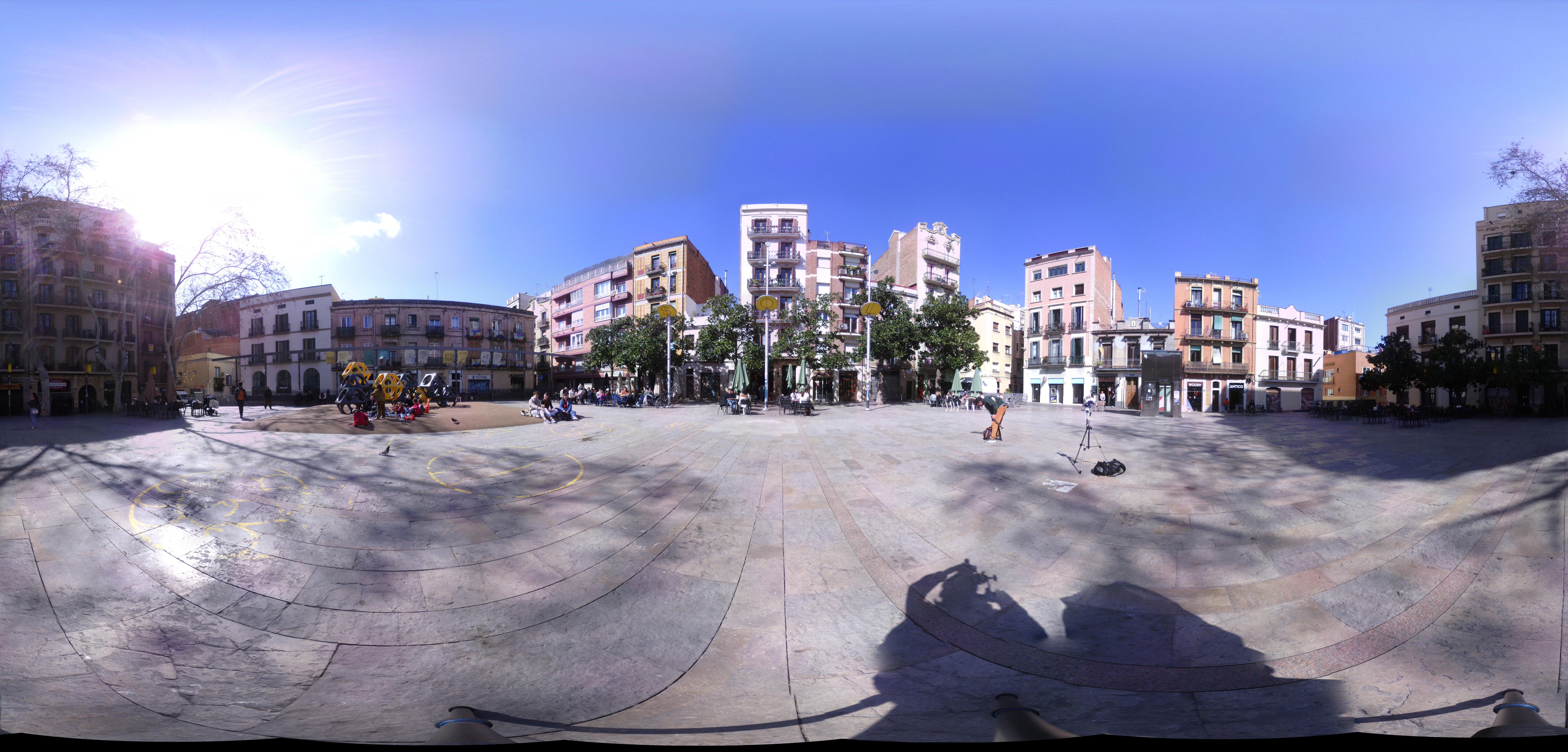
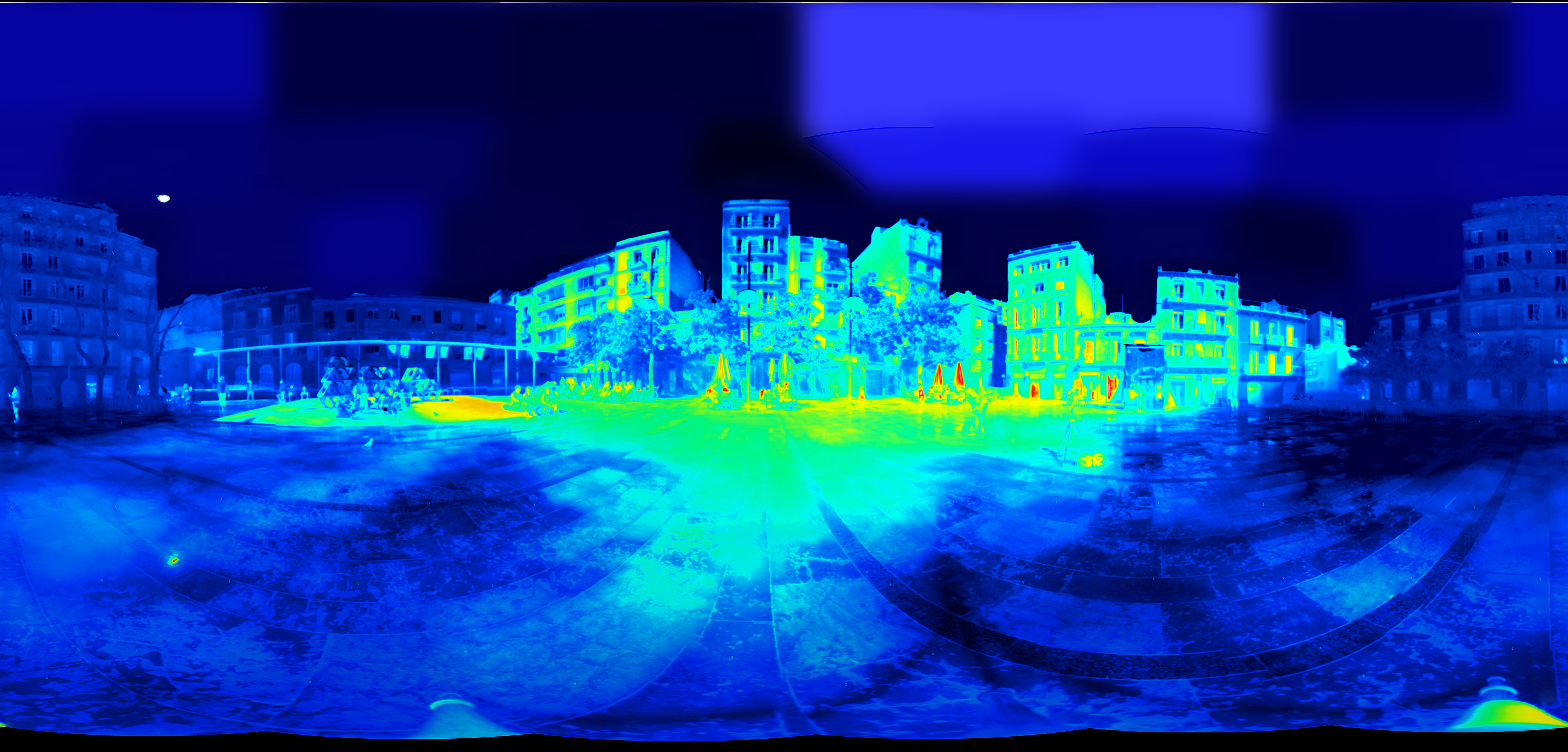
Generating the previous image, of Plaça del Sol, is not an easy task. We are used to viewing images like Google Street View, which can be taken with cameras that have a wide field of view. By contrast, thermal cameras have a limited field of view, so several photographs are needed to obtain a complete image.
Producing a full 360º thermal image involves stitching together 92 thermal photographs, a number determined by the field of view of the camera used. The methodology used by the team to achieve the spherical images will soon be available online, helping to disseminate this tool.
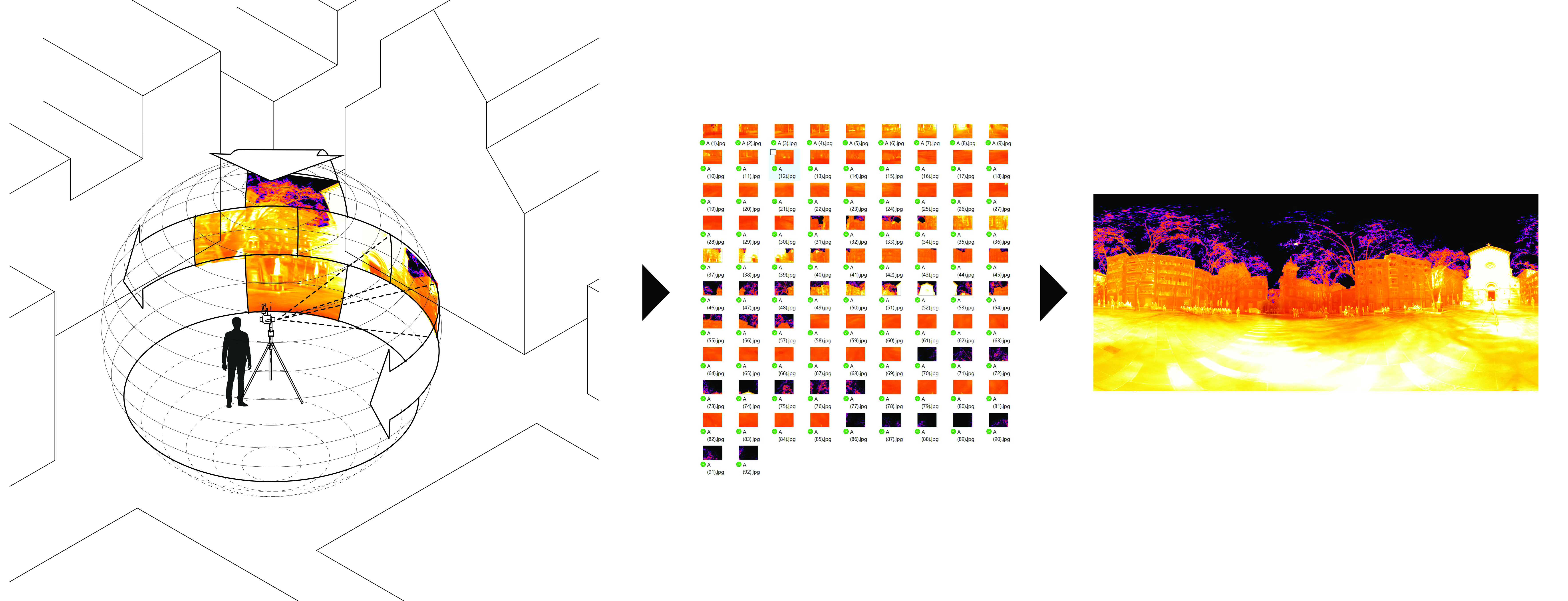
Methodology to create a 360º thermal image.
#Why is it interesting to see the radiant environment?
Seeing the radiant environment is interesting because it helps us better understand how we thermally interact with our surroundings. Unlike air temperature, which is uniform in a given space, radiant temperature can vary significantly depending on the orientation, materials and geometry of the surrounding objects.
We carried out the experiment of photographing the radiant environment throughout one day in Plaça de la Virreina in Barcelona. In the following interactive figure we can see the results.
Plaça de la Virreina, Barcelona (March 31, 2025)
Loading 360º view...

#Conclusions
The spherical thermal image, by its graphic nature, offers very valuable information for environmental design in architecture. Applied to urban spaces, the spherical thermal image makes it possible to detect the energy flows that affect a pedestrian.
Urban surfaces, depending on their exposure to solar radiation, their view factors to the sky vault and their materiality, can have radically different thermal behaviors and have a drastic influence on pedestrian thermal comfort.